← Articles · History
A Genetic, Linguistic, and Imperial History of Iran
By libertybro ·
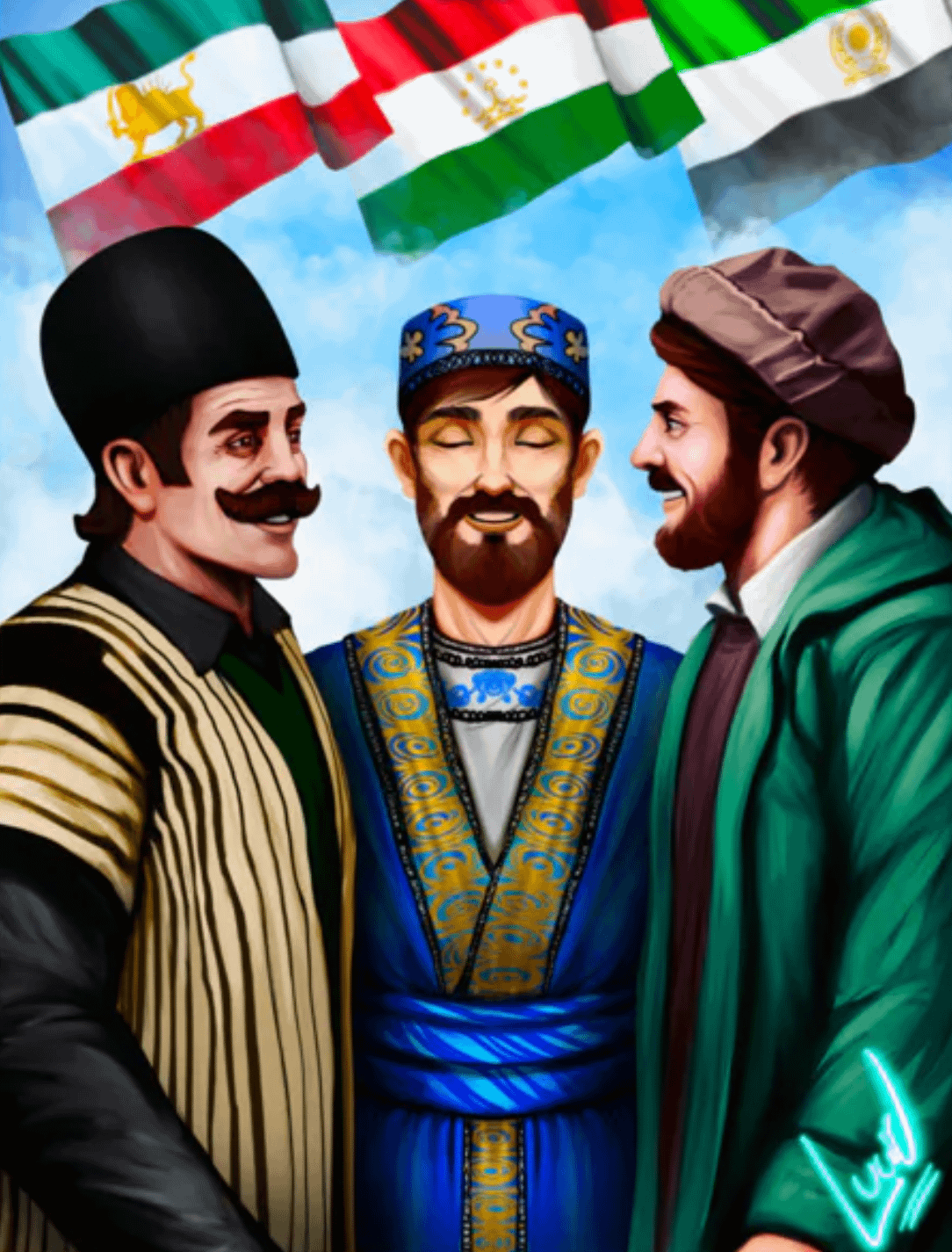
Most history gets taught as a relay race. One civilization runs its leg, collapses, and hands the baton to whoever conquers it next, a new people, a new language, a new population, starting over from zero. That's roughly how the story goes for Egypt, for Mesopotamia, for most of the ancient world.
Iran didn't do that. Not once, in six thousand years.
What actually happened on the Iranian plateau is stranger and more impressive than a relay race. It's closer to one long-distance runner who changed clothes a dozen times but never actually stopped running. Empires rose and fell. Religions arrived and displaced older ones. Conquerors marched through and, in some cases, ruled for centuries. And underneath all of it, the same people, speaking a language descended from the same root, kept going. This is that story, told in three overlapping threads: the blood, the language, and the empires that blood and language built.
Before Persia Was Persia
Start further back than anyone expects. Long before there was a Persian Empire, or Persians, or even the word Iran, there was Elam.
Elam grew up in the southwest of the plateau, centered on the city of Susa, and Susa is old in a way that's hard to fully process. Founded around 4000 BCE, it's roughly as ancient as the earliest Sumerian cities in Mesopotamia, meaning Iranian urban civilization isn't a footnote that shows up after Mesopotamia's story gets going. It's there at the starting line.
Elam wasn't Sumerian, and it wasn't a junior partner. It spoke its own language, a language isolate, meaning it has no known relatives anywhere on earth, dead or living, a total linguistic orphan. It worshipped its own gods. And for something like two thousand years, it traded, warred, and negotiated with Sumer, Akkad, and Babylon as a genuine peer, not a client state. At its most aggressive, Elam raided deep into Mesopotamia and hauled off sacred statuary from the city of Ur as war trophies. This was a civilization that gave as good as it got against the oldest cities on earth.
Some of what Elam built is still standing. The ziggurat at Chogha Zanbil, a massive stepped temple complex, remains one of the best preserved structures of its kind anywhere in the world. It's protected today as a UNESCO World Heritage site, a working piece of religious architecture you can still walk around, roughly three thousand years after it was built.
Elam eventually got absorbed, first into the Median sphere, then fully into the Achaemenid Empire. But absorbed doesn't mean erased. Elamite didn't disappear when the Persians took over, it became one of the three official languages the Achaemenids used to run their empire, carved right alongside Old Persian and Akkadian into royal inscriptions. Elamite scribes and administrative traditions shaped how the first Persian empire actually governed itself. The apprentice, in a real sense, absorbed the workshop.
So before you even get to Cyrus, the plateau already has three thousand years of continuous civilization behind it.
The Genetic Thread
Here's where it gets genuinely strange, and where the science backs up something people have argued about culturally for a long time.
A study published in 2025 sequenced ancient DNA from fifty individuals recovered across nine archaeological sites in Iran, spanning from 4700 BCE all the way to 1300 CE. That's nearly six thousand years of skeletons. Researchers deliberately sampled heavily around the Achaemenid, Parthian, and Sassanid periods specifically to test what happens to a population's genetics through waves of empire, invasion, and religious conversion.
The finding: remarkably little happened to it. Despite the Achaemenids falling to Alexander, despite the Parthians and Sassanids fighting Rome for the better part of a millennium, despite the Arab conquest and the arrival of Islam, the underlying population of the Iranian plateau stayed genetically continuous the entire time. It's one of the most extensive, best-documented cases of long-term population continuity found anywhere in the ancient world. Genetic markers from skeletons buried three thousand years ago still show up in Iranians walking around today.
This isn't a faint statistical signal buried in a spreadsheet somewhere either. Researchers found the same maternal and paternal lineage markers recurring across skeletons separated by thousands of years and multiple regime changes, samples from graves in the Achaemenid era sharing clear ancestry with samples from a thousand years later, and both of those sharing ancestry with people living in Iran right now. Empires changed hands overhead, again and again. The people underneath mostly just kept having children with each other.
There's a second, quietly remarkable finding buried in the same research. Modern Iran is home to Persian speakers, Kurdish speakers, Turkic-speaking Azeris, and Arabic-speaking Iranian Arabs, groups that on paper look like separate peoples who arrived from separate places. The genetics say otherwise. Azeris and Iranian Arabs share substantial ancestry with Persians and Kurds. The language changed. The population underneath it mostly didn't. People adopted new languages the way you'd adopt a new tool, without being replaced as a population to make room for someone else.
That reframes everything that follows. The empires you're about to hear about weren't waves of different peoples taking turns on the same stretch of land. They were mostly the same people, generation after generation, building different political structures on top of themselves.
Cyrus and the First Superpower
By 550 BCE, a Persian king named Cyrus had done something nobody had managed before: he built an empire bigger than any that had existed. The Achaemenid Empire, at its height, stretched from the Balkans to the edge of India, the largest empire the ancient world had yet seen.
Cyrus is remembered for more than scale. After conquering Babylon, he issued a proclamation, recorded on what's now called the Cyrus Cylinder, that's often cited as one of the earliest documented acts of religious tolerance by a conquering power, releasing peoples the Babylonians had displaced, the Jewish population among them, and allowing them to return home. The Hebrew Bible itself remembers this favorably, naming Cyrus directly in the Book of Isaiah as an instrument of divine will, a striking thing for a foreign king to earn in someone else's sacred text.
Running an empire that size required invention, not just conquest. The Achaemenids built the Royal Road, a highway system with staffed relay stations that let messages travel across thousands of miles faster than anything Europe would manage for another two thousand years. They divided the empire into satrapies, provinces run by governors answerable to the crown, a template later empires, including Rome's, would borrow from directly. This wasn't just a big army. It was the first real attempt at administering genuine diversity, dozens of languages, religions, and cultures, under a single, functioning bureaucracy. Some historians estimate that at its peak the empire governed something close to half of the entire world's population at the time, an almost unthinkable share for one political structure to hold, especially one that didn't try to erase the differences underneath it.
Cyrus's successor, Darius I, pushed the machine further and, almost by accident, left historians one of the most useful documents ever recovered. High up a cliff face at Behistun, hard to reach on purpose, Darius had his own account of his rise to power carved in three languages at once, Old Persian, Elamite, and Babylonian, describing the same events three times over. When scholars in the nineteenth century finally cracked how to read it, that trilingual inscription did for cuneiform what the Rosetta Stone did for Egyptian hieroglyphs. An entire branch of ancient history became legible because a Persian king wanted his victories remembered in triplicate.
The empire also solved a problem most of the ancient world never came close to cracking: how to grow food and support real cities in a landscape that's mostly desert and mountain. The answer was the qanat, a gently sloping underground tunnel that carries water by gravity alone from an aquifer at the base of a mountain to farmland and towns, sometimes running for kilometers, dug and maintained entirely by hand. Qanats spread across the empire, and in a detail that's genuinely hard to believe, thousands of them are still working today, over two thousand years later, still moving water with the same design and no modern pumps involved.
Rome Learns
Skip forward a few centuries. The Achaemenids are long gone, defeated by Alexander, but the plateau's habit of producing serious military powers hasn't gone anywhere. Enter the Parthians.
In 53 BCE, one of the richest men in Rome, Marcus Licinius Crassus, decided an unprovoked invasion of Parthian territory would be an easy way to match the military glory of his rivals Pompey and Caesar. He marched roughly forty thousand men into Mesopotamia. He never came home.
At Carrhae, a Parthian commander named Surena met Crassus's legions with a force built almost entirely around cavalry, heavily armored cataphracts and horse archers riding composite bows with more range and power than anything the Romans had faced. The horse archers used a tactic so effective it left its name permanently in the English language: they'd retreat at full gallop while twisting in the saddle to fire backward at the pursuing enemy, the origin of the phrase "Parthian shot." Crassus's army was encircled on open ground with nowhere to run. Something close to half his force died there. Crassus himself was killed attempting to negotiate. It remains one of the worst defeats in Roman military history, on the same level as Hannibal's victory at Cannae generations earlier.
Rome never actually avenged Carrhae by force. Decades later, in 20 BCE, the emperor Augustus finally got the legionary standards Crassus had lost handed back, not through a battlefield victory, but through negotiation. Augustus still had a triumphal arch built to commemorate getting them back, since talking the standards loose was about as close to closure as Rome ever managed.
Rome would spend the next several centuries trying, on and off, to settle that score by other means. It rarely went well.
The Emperor in a Cage
The Parthians eventually gave way to a new Persian dynasty, the Sassanids, who didn't just match their predecessors' hostility toward Rome, they escalated it.
Valerian's capture wasn't a lucky, isolated strike. Shapur had already spent years tearing through Roman territory before that, sacking Antioch, one of the largest cities in the entire eastern empire, more than once. By the time Valerian marched east to finally confront him directly, Shapur was already the most feared man on Rome's eastern frontier.
In 260 CE, that same Roman Emperor Valerian marched east with a massive army to confront the Sassanid king Shapur I. At Edessa, Shapur's forces destroyed the Roman army and captured Valerian alive. Shapur had the moment carved permanently into a monumental rock inscription in his own words, describing taking the Roman emperor prisoner with his own hands, along with his senior officers and senators. It remains the only time in Roman history an emperor was captured alive by a foreign power. Later writers, Roman and Christian sources among them, added increasingly dramatic and disputed details about Valerian's treatment in captivity, details historians still argue over the reliability of. What isn't disputed is the plain fact underneath the legend: the ruler of Rome ended his life as a prisoner of a Persian king, and Persia made sure the story got carved in stone so nobody would forget it.
The wars between Rome, and later Byzantium, and the Sassanids stretched on for centuries, a rivalry between the two great powers of late antiquity that shaped the entire Near East long before either empire encountered the force that would eventually reshape the region entirely: the armies of the new Islamic caliphate in the seventh century.
A Language With Deep Roots
Persian didn't spring up out of nowhere either. It belongs to the Indo-Iranian branch of the Indo-European language family, the same enormous family tree that includes Sanskrit, Greek, Latin, and eventually English, which makes Persian and Sanskrit distant linguistic cousins. Old Persian, the language Darius had carved into that cliff at Behistun, is the root of the whole line, sitting alongside Avestan as one of the two earliest recorded members of the Iranian branch.
Old Persian didn't freeze in place. By the Sassanid era it had evolved into Middle Persian, usually called Pahlavi, the administrative language of the empire that fought Rome to a standstill for centuries. After the Arab conquest, Middle Persian evolved again into New Persian, the direct ancestor of the language spoken across Iran, Afghanistan, and Tajikistan today. New Persian absorbed a huge amount of Arabic vocabulary through the conquest, the same way English absorbed enormous amounts of French after 1066, but its grammar, its verb system, its core structure stayed intact the whole way through. It's still, unmistakably, one continuous language that started three thousand years ago on a cliff face in the Zagros mountains. That continuity is exactly what was on the line when Arabic became the empire's dominant language of scholarship and government.
The Sheer Will Of the BVSEDGQDS To Keep The Language Alive (And They Did)
This is the thread most people miss entirely, and it might be the most impressive one of all.
When Arab armies conquered the Sassanid Empire in the seventh century, they didn't just conquer a kingdom, they brought a new religion, a new administrative language, and an entirely different linguistic family with them, Semitic Arabic replacing what had been an Indo-European Persian world. This is exactly the kind of conquest that erases languages. It happened almost everywhere else it was tried.
Look at Egypt. Egypt had one of the oldest, richest civilizations on the planet, and yet after the same seventh century Arab conquests, Egyptian, the language of the pharaohs, eventually died out almost entirely as an everyday spoken language, surviving only in the liturgy of the Coptic church. Ask a historian why, and you'll sometimes get an answer that's blunt about exactly what was missing: Egypt simply had no equivalent figure to what Persia had.
Persia had Ferdowsi.
A few generations after the conquest, a poet named Rudaki, working at the court of the Samanid dynasty in the east, began composing serious literary poetry in New Persian, proving the language could carry the weight of high art even while Arabic dominated scholarship and government. He's remembered as the father of Persian poetry, though tragically only a fraction of his work survives today. A poet named Daqiqi picked up the project of retelling Iran's pre-Islamic royal history in verse, but died before finishing it.
It was Abu'l-Qasem Ferdowsi, born in the province of Khorasan in the tenth century, who finished the job on a scale nobody else attempted. Over the course of decades, he composed the Shahnameh, the Book of Kings, some fifty thousand couplets recounting Iran's mythology and history from creation up through the fall of the Sassanids. It stands as the longest poem ever written by a single author. Ferdowsi wrote it deliberately in Persian, minimizing Arabic loanwords at a time when Arabic dominated every prestigious form of writing, specifically to keep the language, and the pre-Islamic memory riding inside it, alive. It worked. Historians studying the era credit the Shahnameh directly with anchoring Persian as a living literary language through the exact period when it could easily have gone the way of Egyptian.
The result is something genuinely rare. Of every people the seventh century Arab conquests swept over, Persia is one of the very few that kept a major, continuous, high literary tradition in its own pre-conquest language. Not preserved in a museum. Actually used, actually read, actually recited, for the next thousand years and counting.
The Golden Age Within the Golden Age
The centuries that followed are usually filed under the Islamic Golden Age, and that framing is accurate, but it undersells how much of that golden age ran on Persian minds specifically, working in a hybrid civilization that was simultaneously Islamic and unmistakably Persianate.
Even the engine room of the broader project had unmistakably Persian fingerprints on it from the start. The Barmakids, a powerful family of Persian administrators, effectively ran the day-to-day machinery of the early Abbasid Caliphate out of Baghdad, and they were among the key patrons behind the great translation movement that pulled Greek, Persian, and Indian scientific and philosophical texts into Arabic, the intellectual seed stock for pretty much everything that followed.
Ibn Sina, known in the West as Avicenna, born near Bukhara in Persian Central Asia, wrote the Canon of Medicine, a systematic medical encyclopedia that became the standard reference text in European universities for roughly six hundred years. Al-Khwarizmi's mathematical work, produced within a Persian-influenced court culture, is where the word algebra itself comes from, and his own name is the root of the word algorithm. Omar Khayyam did genuinely advanced work on the classification and solution of cubic equations centuries before European mathematicians caught up, while simultaneously writing some of the most enduring poetry in the Persian language.
None of that happened in spite of the Arab conquest. It happened inside the civilization the conquest created, with Persian language, administrative habits, and intellectual traditions running through the whole enterprise as one of its central engines, not a footnote to it.
The poetic tradition Ferdowsi fought to keep alive didn't stop with him. It kept producing giants for centuries afterward. Rumi, writing in the thirteenth century, became one of the most widely read poets on the planet, his lines on love still quoted globally today, often by people who have no idea where they actually came from. Hafez, a century later, wrote lyric poetry so revered that copies of his collected work still sit in homes across Iran today, used half-seriously and half-sincerely for guidance, flipping open a random page the way some households use scripture. Saadi's writing on the shared bond of humanity was admired widely enough, long after his death, to end up inscribed in a hall of the United Nations headquarters, a Persian poet's words chosen to represent the whole idea of common humanity on a world stage.
A Language That Became an Empire of Its Own
By the time the Mongol invasions had swept through and receded, Persian had managed something remarkable that had nothing to do with any Persian government's actual military power: it had become the prestige language of an enormous stretch of Asia that Iran itself never ruled.
The Mughal Empire in India ran its administration, its poetry, and its high culture substantially in Persian for centuries, right up until the British colonial period took over. Ottoman elites studied and composed Persian poetry as a mark of sophistication at their own court, in their own empire, speaking their own first language. Courts stretching from Central Asia toward the edges of China used Persian as the shared language of diplomacy and literature. A poet born in a small town on the Iranian plateau could end up quoted centuries later in a royal court a thousand miles away, in an empire that had nothing to do with Iran politically, purely because the language itself had become the currency of educated taste across half a continent.
Isfahan, Half the World
Centuries later, the Safavid dynasty pulled Iran back together as a unified, self-consciously Persian state after long stretches of fragmentation and outside rule. Under Shah Abbas the Great, the capital at Isfahan became one of the most staggering cities on earth, its central square, its bridges, its blue-tiled mosques built on a scale meant to announce that Persian civilization was not a memory, it was fully, aggressively alive again. A saying about the city took hold that's survived to this day, roughly translated as Isfahan being half the world, the idea that you didn't need to travel anywhere else because everything worth seeing had been gathered into one place.
The Unbroken Line
Put the three threads back together and the shape of the whole story becomes obvious.
The bones say the population barely moved in six thousand years. The language says something almost as improbable: a linguistic tradition that watched its own political independence collapse and, instead of dying with it, produced one of the longest poems ever written specifically to make sure it didn't. And the empires, Elam, the Achaemenids, the Parthians, the Sassanids, the Persianate courts of the Islamic centuries, the Safavids, read less like a chain of unrelated conquerors trading a piece of land back and forth, and more like the same civilization, again and again, refusing to accept that its last chapter was actually its last.
Most places that get conquered end up as a story about what was lost. Iran is one of the rare places where you can trace, in the DNA, in the grammar, and in the couplets people still recite from memory, exactly what never actually broke.
That's the part worth sitting with. Not that Iran has old history, plenty of places do. It's that the history never really became past tense. The same land, largely the same people, and a language that watched its own political independence collapse and simply refused to go quiet, kept writing, kept building, kept getting handed forward, generation after generation, for six thousand years running. Most civilizations get one great chapter before they're absorbed into someone else's story. This one kept writing its own.